Frequently Asked Questions

Dragon Bravo Fire Aftermath 2026

The Dragon Bravo Fire of 2025 undeniably changed the landscape of the North Rim, but its aftermath offers a rare, front-row seat to the incredible resilience of nature.

Despite the scars, the North Rim’s signature solitude and cooler temperatures remain, offering a quieter, more reflective experience than the crowded South Rim.

F.A.Q's

Was Jacob Lake Inn affected by the Fire?

No — Jacob Lake Inn was not destroyed or damaged by the Dragon Bravo Fire, but it was heavily affected by the surrounding fires and evacuations.

What happened

In July 2025, the Dragon Bravo Fire burned over 145,000 acres around the Grand Canyon’s North Rim and destroyed more than 100 structures, including the historic Grand Canyon Lodge.

At the same time, the nearby White Sage Fire burned nearly 59,000 acres northeast of Jacob Lake, threatening the area around the inn. This caused an evacuation and closure of the Property for 3 Weeks.

Current status (after the fires)

The inn reopened once conditions allowed and remained standing.

Jacob Lake Inn is now one of the few hotels remaining on the North Rim. The property offers a full range of amenities, including hotel rooms, motel accommodations, cabins, a restaurant and café, plus a gift shop and bakery. It has truly become the gateway to the North Rim

This is just a taste of what Jacob Lake Inn has to offer!

As of March 15, 2026, the North Rim of the Grand Canyon  is in a phased reopening process following the 2025 Dragon Bravo Fire. While most of the North Rim remains seasonally closed for winter, key progress has been made on the North Kaibab Trail, and a broader reopening is tentatively planned for May 15, 2026.

2026 Season Outlook
  • Tentative Reopening Date: The National Park Service aims for a phased seasonal opening on May 15, 2026, weather and safety conditions permitting.
  • Visitor Services: There will be no overnight lodging available at the North Rim in 2026 due to the loss of the Grand Canyon Lodge. Services will likely be limited to day-use only, and the North Rim Campground’s status is still being evaluated.
  • Official Updates: The park has committed to providing more specific details regarding the 2026 season no later than April 1, 2026.
     

For the latest official alerts, you should monitor the Grand Canyon National Park News Releases and the Kaibab National Forest Alerts pages.

National Park Service (.gov)National Park Service 
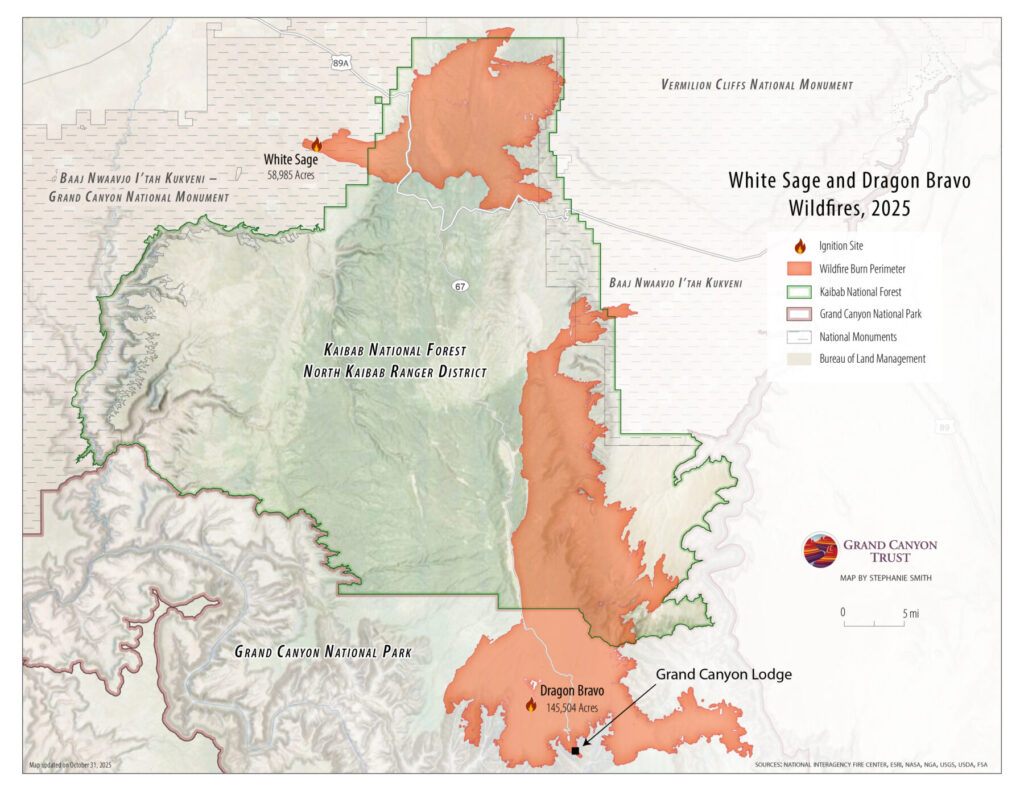
The Dragon Bravo Fire of 2025 damaged approximately 6% of Grand Canyon National Park and 12% of the Kaibab National Forest’s total land area.
 
  • Grand Canyon National Park: The fire burned 71,129 acres of the park’s total 1.2 million acres, which is roughly 5.9%. Nearly the entire burn occurred on the North Rim, affecting a significant portion of its developed and forested zones.
  • Kaibab National Forest: The fire consumed approximately 78,270 acres (combined with the adjacent White Sage Fire, nearly 205,500 acres of public lands were affected in the region). Given the Kaibab National Forest covers about 1.6 million acres, the Dragon Bravo Fire alone impacted roughly 4.9%, though its impact on the North Kaibab Ranger District specifically was much higher, with the district seeing nearly 90% of its area temporarily closed during the peak of the incident.
  • Total Burned Area: The fire’s final footprint was 149,399 acres, making it the seventh-largest wildfire in Arizona history.
  • Burn Severity: Despite the massive size, the damage was largely a “mosaic” pattern. Within the National Park, 68% of the area burned at low severity, 24% at moderate severity, and only 1% at high severity.

While the Grand Canyon Lodge and Visitor Centers were destroyed, much of what makes the North Rim Special Survived. 

Check the National Park Service for up to date Information!

———————————————————————————-
Trail Status and Current Closures as of 3/31/2026

OPEN CURRENTLY:

  • South Kaibab Trail from the South Kaibab Trailhead to Phantom Ranch.
  • Tonto Trail from Tipoff to Havasupai Gardens.
  • Bright Angel Trail is open from the Bright Angel Trailhead to the River Resthouse.
  • Phantom Ranch, Bright Angel Campground, and the North Kaibab Trail from Phantom Ranch to Ribbon Falls.


CLOSED DUE TO SEASONAL CLOSURES AND IMPACTS FROM THE DRAGON BRAVO FIRE:

  • The North Kaibab Trail north of the Ribbon Falls junction to the North Kaibab Trailhead. This section of trail will reopen on May 15, 2026.
  • The Arizona Trail through Grand Canyon National Park (trail assessments are ongoing).
  • Widforss Trail
  • Transept Trail
  • Bridle Path
  • Ken Patrick Trail South of Cape Royal Road
  • Uncle Jim Loop
  • Ken Patrick Trail
  • Cape Royal Trail
  • Cliff Spring Trail
  • Cape Final Trail
  • Roosevelt Point Trail


See the current trail condition!

North Kaibab Trail – Supai Tunnel – Trailhead (5/15/26)

https://www.facebook.com/reel/1382766716912854

Jacob Lake Inn is open year-round supplying accommodations and services to travelers during every month of the year. 

Our cabin accommodations close during the winter months as we work to winterize our historic cabins. Closures of cabins will begin as temperatures begin approaching below freezing, but our motel and hotel rooms remain open for guests all through the winter.

No, we currently do not offer laundry services or shower services due to water limitations on the plateau. All of our rooms have full showers and bath, but we do not have any separate shower services for travelers who are not currently staying with us. The nearest options for both showers and laundry can be found in Kanab, Utah, about 40 miles north of us.

We do not have any campground accommodations, however, the Kaibab Camper Village and the Jacob Lake Campground both offer camping services within a 1/2 mile radius of our location. Other designated campgrounds can be found on the Forest Service website here. Dispersed camping is also permitted within the National Forest; details are available online.

Jacob Lake is a small pond that collects rainwater and can be found about a mile from Jacob Lake Inn. It can be accessed via a short drive down a forest road off of Highway 67 or along a trail that starts at Jacob Lake Inn. In recent years, due to drought and reduced rainfall, Jacob Lake is often a small marsh or meadow during most of the year. Though it was never large and not the traditional size of what most would define as a lake, it was a vital source of water for the Kaibab Paiutes, and other people journeying through the region for centuries. 

The reason for its name, Jacob Lake, is historically significant. Jacob Hamblin, a Mormon missionary and explorer was asked by Latter Day Saint prophet, Brigham Young, to work with the Paiutes, Navajo, Hopi, and other Native American tribes in the region to help make safe passage for travelers through their lands. Out of mutual respect, Jacob Hamblin was shown the lake as a source of water by the Kaibab Paiutes who lived on the dry Kaibab Plateau. Over time, through his directions toward the area, it became increasingly referred to by other settlers and pioneers as “Jacob’s Lake” or simply “Jacob Lake.”

Due to the proximity to Jacob Lake, the founders of Jacob Lake Inn, Harold Israel Bowman Sr and his wife, Nina Nixon Bowman, named their first gas station and general store after the lake. Their first store, gas station, and cabins stood near the lake for several years until an official highway to the North Rim was planned. The Bowmans then moved to their current location about a mile from the lake, yet still retained the name, Jacob Lake Inn.

Due to water limitations on the plateau, we do not currently offer fill-ups for RV’s or large drinking containers above 30 gallons. However, for personal drinking containers up to 30 gallons, our staff will be able to fill them up for you at a cost determined by the quantity of water provided.